On This Page
Why Azure Data Engineering in 2026
The demand for Azure Data Engineers continues to surge in 2026, driven by enterprises accelerating their cloud migrations and the explosion of real-time analytics use cases. Microsoft Azure now holds a 23% share of the global cloud market, and organizations across banking, healthcare, retail, and manufacturing are building their data platforms on Azure.
What makes Azure particularly compelling is the tight integration between its services. Azure Data Factory, Synapse Analytics, Databricks, and Azure Data Lake Storage form a cohesive ecosystem that lets engineers build end-to-end pipelines without stitching together disparate tools.
"The ability to orchestrate, transform, and serve data — all within a single governed Azure environment — is what separates enterprise-grade solutions from one-off scripts."
Core Azure Services to Master
Before diving into certifications, it is essential to have hands-on experience with the services that appear on every Azure Data Engineer role description and every exam:
- Azure Data Factory (ADF) — The backbone of pipeline orchestration. Master linked services, integration runtimes, mapping data flows, and triggers.
- Azure Synapse Analytics — The unified analytics platform combining data warehousing, big data, and data integration. Understand dedicated SQL pools, serverless SQL, and Spark pools.
- Azure Databricks — Delta Lake, PySpark, and MLflow on Azure. Increasingly central to both data engineering and ML workloads.
- Azure Data Lake Storage Gen2 (ADLS) — Hierarchical namespace, RBAC, and lifecycle management. Every pipeline touches it.
- Azure Stream Analytics & Event Hubs — Real-time ingestion and processing are table stakes for modern data platforms.
The monitoring layer
Do not overlook Azure Monitor, Log Analytics, and Purview. Exam DP-203 tests your knowledge of data governance, monitoring pipeline runs, and implementing observability — skills that set senior engineers apart from juniors.
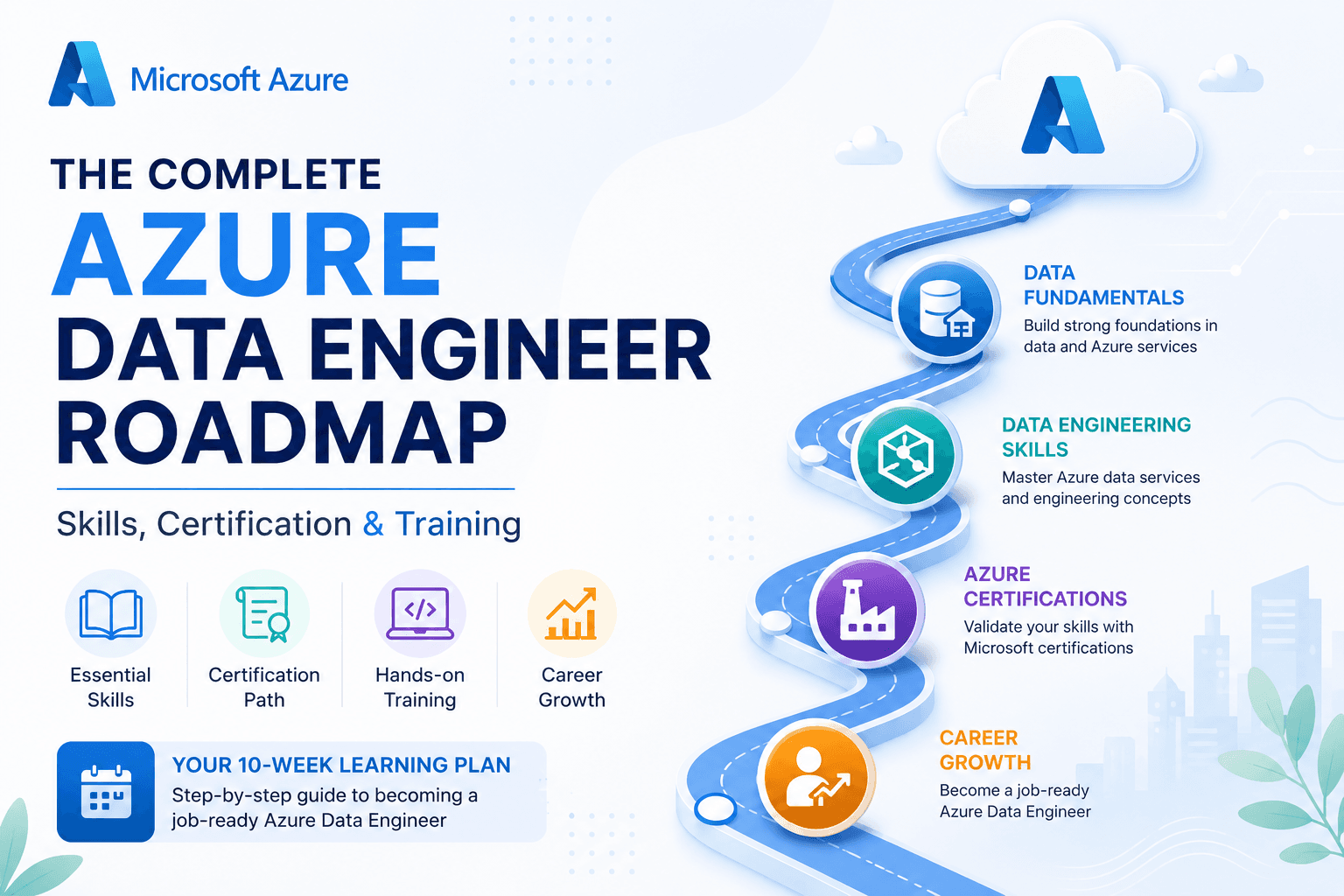
The Certification Path
The official Azure Data Engineer certification path is structured progressively. Most candidates benefit from following this sequence:
- AZ-900 (optional but useful) — Azure Fundamentals. Good for building a mental model of the platform.
- DP-900 — Azure Data Fundamentals. Covers core data concepts and Azure data services at a conceptual level.
- DP-203 — Azure Data Engineer Associate. The core certification. Covers ADF, Synapse, ADLS, Databricks integration, and security.
- DP-600 — Implementing Analytics Solutions Using Microsoft Fabric. The emerging certification for the Fabric-first future.
# Example: ADF pipeline trigger using Azure CLI
az datafactory trigger create \
  --factory-name myDataFactory \
  --resource-group myRG \
  --name myScheduleTrigger \
  --properties @trigger.json
Your 6-Month Learning Roadmap
Based on coaching hundreds of candidates, here is the roadmap that consistently produces the best outcomes — balancing theory, hands-on labs, and exam preparation:
- Month 1–2: Core services fundamentals. Build three end-to-end pipelines in ADF. Complete Microsoft Learn paths for DP-203.
- Month 3: Synapse Analytics deep dive. Build a star schema, write T-SQL queries, configure row-level security.
- Month 4: Databricks on Azure. Delta Live Tables, Auto Loader, and Unity Catalog. Complete a real project with ADLS.
- Month 5: Exam preparation. Practice tests, review weak areas, focus on monitoring and security modules.
- Month 6: Take DP-203. Then start DP-600 if Fabric is on your roadmap.
"Hands-on lab time is non-negotiable. Reading documentation is not the same as debugging a broken pipeline at 11pm before a demo."
Common Mistakes to Avoid
The candidates who fail DP-203 on their first attempt almost always make one or more of these mistakes:
- Skipping Synapse serverless SQL — it appears heavily on the exam and is underrepresented in study materials.
- Ignoring security topics: RBAC, private endpoints, managed identities, and encryption at rest.
- Not practicing with the Azure portal. The exam has scenario-based questions that require familiarity with the actual UI.
- Underestimating the streaming section — Event Hubs, Stream Analytics, and real-time patterns are always tested.
Conclusion
Azure Data Engineering is one of the highest-ROI skills you can build in 2026. The combination of strong demand, clear certification paths, and the depth of the Azure ecosystem makes it a compelling career investment for both experienced engineers and those switching from adjacent roles.
If you want a structured path with expert guidance — our Azure Data Engineer training program covers all of the above with 1-on-1 sessions, real project work, and full exam preparation support.
Rahul Sharma
·Senior Cloud Architect
Rahul is a Senior Cloud Architect with over 10 years of experience designing enterprise-grade data solutions on Azure, AWS, and GCP. He has helped 200+ professionals pass Azure certifications and transition into cloud data roles.
Connect on LinkedIn